
There has been a lot of speculation and uncertainty about the current situation at Fukushima Dai-Ichi nuclear plant. According to NHK World(Japanese TV channel) there is no healt risk in the area and the radiation amounts are low. Still, even military helicopters are seen to fly near the nuclear plant picking up seawater, but then seen to leave the area. This can mean that, either it's an exercise or it's a alarming sign that there was too much radiation. Even the people of Japan are suspicious and do not trust the information that has been given by the officials in Japan. They think that japanese officials are just trying to avoid mass panic, therefore do not give complete picture to the people. So, because of this, it's very difficult to know the severity of this situation. Well, everyone can monitor the information and what is happening in Fukushima for themselves.
Fukushima Dai-Ichi nuclear power plant has a BWR (Boiling Water Reactor) six of them infact. This means that, at the core, nuclear reaction is used to heat the water to steam, which in turn moves the turbines to create electricity. Fuels that are used in these reactors are low enriched uranium-235 and Mixed-oxide fuel (partly plutonium and natural uranium, other mixes are possible).
The nuclear reaction, fission, is the foundation for nuclear power plants. The radioactive decay of fissile or fertile materials, cause a nuclear chainreaction that generates high amounts of different kind of radiation, most notable Gamma and electromagnetic radiation. The nuclear fission in which a heavier nuclei split into two lighter nucleus, releases also kinetic energy (heat) in the fissile material that houses the reaction.
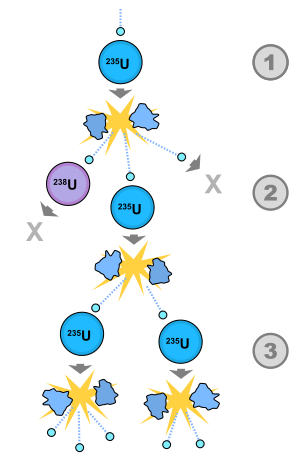
I most cases, the fuel used is enriched uranium-235 (unstabel isotope of uranium). The fuel is in the form of pencil thick rods that are submerged in light water. The reaction is controlled by control rods made out of neutron poisons, meaning materials that absorb neutrons. Neutrons are the catalyst to the nuclear fission (both in bombs and in power reactors, deifference being the speed of the reaction). Neutrons that hit the Uranium-235 nuclei, cause it to split, releasing energy and further neutrons that cause further reactions. The fuel rods heat up in this nuclear reaction and turn water into steam.

To control the nuclear fission at the core, there are control rods between the fuel rods, absorbing free neutrons to limit and lower the reaction speed. Needles to say, the reactors need to be cooled all the time to prevent the fuel rods to melt. Meltdown could cause the fuel rods to melt through the radiation shield, thus releasing radioactive materials to air. Worst case scenario, the melting core could fuse together and reach critical mass. Causing a nuclear explosion. Uranium-235 is needed 53 kg and in a diameter of 17cm. Low enriched uranium-235 neded for critical mass is over 400kg.

No comments:
Post a Comment